
Introduction
Artificial Intelligence is evolving faster than ever — and the latest revolution is Multimodal AI.
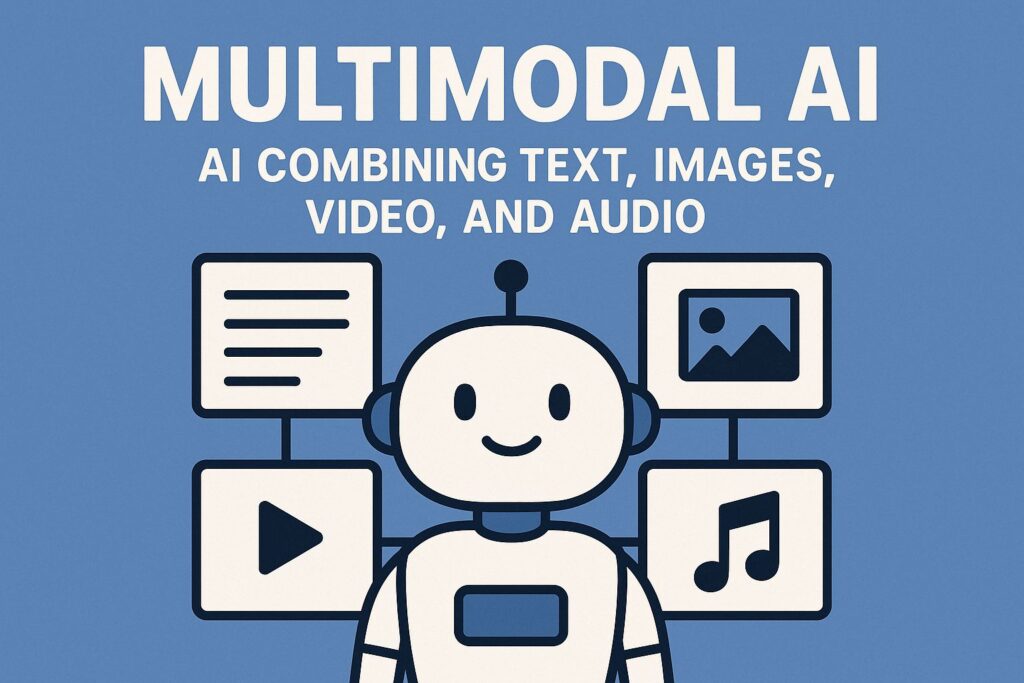
While traditional AI models could process only one type of data (like text or images), Multimodal AI can understand and generate information across text, images, audio, and video — all at once.
In 2025, this technology is reshaping how humans and machines interact, bringing us closer to truly intelligent, context-aware systems.
What is Multimodal AI?
Multimodal AI refers to artificial intelligence systems that can process, understand, and generate multiple types of data simultaneously.
For example, while a text-based chatbot understands only written input, a multimodal model can:
- Read your text,
- Analyze an image you upload,
- Listen to your voice, and
- Respond with a combination of visuals and words.
Popular examples include OpenAI’s GPT-4o, Google’s Gemini, and Meta’s ImageBind — all capable of understanding and generating across multiple data modes.
How Multimodal AI Works
At its core, multimodal AI fuses information from different sources (modalities) into one unified understanding.
Here’s how it works:
- Input Collection: The model receives various types of inputs like text, image, or audio.
- Feature Extraction: Each input type is converted into a numerical representation (called embeddings).
- Fusion Layer: These embeddings are merged into one shared representation.
- Output Generation: The model produces outputs — for instance, a description of an image, a summary of a video, or an answer combining text and visuals.
Applications of Multimodal AI in 2025
1. Education & Learning
Imagine AI tutors that can watch your facial expressions, listen to your tone, and adjust explanations based on how engaged or confused you are.
2. E-Commerce
Multimodal AI helps recommend products based on both text and visual search — for example, “Find shoes like this picture under $100.”
3. Content Creation
Creators can now generate videos or images directly from text prompts, or even edit media through natural language commands.
4. Healthcare
Doctors can upload medical images, patient history, and notes — and AI can provide holistic insights, improving diagnosis accuracy.
5. Customer Support
AI agents can understand tone, facial cues (in video calls), and text to provide empathetic, context-aware assistance.
Why Multimodal AI Matters
The power of multimodal AI lies in context comprehension.
Humans naturally combine what we see, hear, and read — now AI can too.
This means:
- More accurate outputs,
- More natural interactions, and
- Better real-world adaptability for industries.
It’s not just smart — it’s human-like intelligence in digital form.
Challenges Ahead
Despite its promise, multimodal AI faces hurdles like:
- High computation costs for training,
- Data alignment issues across modalities,
- Privacy concerns when combining personal media inputs.
However, as hardware becomes faster and datasets improve, these challenges are being rapidly addressed.
The Future of Multimodal AI
By 2026 and beyond, multimodal AI will power most enterprise systems, from smart assistants to real-time analytics.
We’re moving toward AI that can understand the world like humans do — through all senses.
It’s not just about language anymore. It’s about experience.
Conclusion
Multimodal AI is redefining what’s possible with artificial intelligence.
By integrating text, image, video, and audio, it creates more intuitive, creative, and context-aware systems — unlocking a new era of human-AI collaboration.
Whether you’re a student, creator, or enterprise leader, understanding and leveraging multimodal AI will be a key skill in 2025 and beyond.