
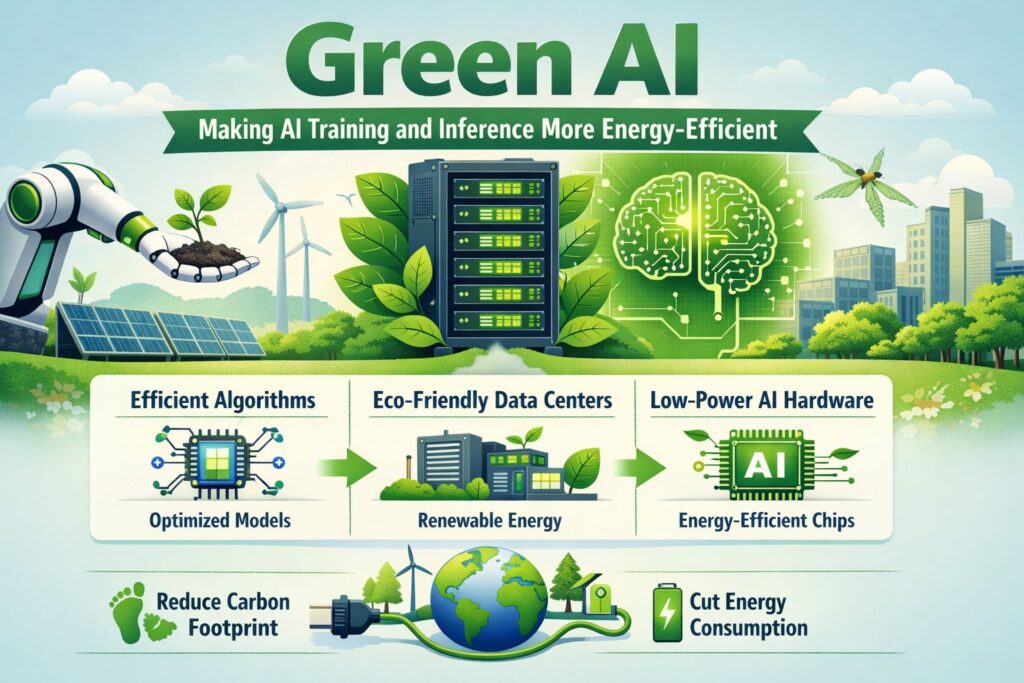

Artificial Intelligence is transforming industries — from healthcare and finance to marketing and education. But as AI models grow larger and more powerful, they also consume massive amounts of energy. This growing environmental impact has led to a new movement in the AI world: Green AI.
Green AI focuses on making AI systems more energy-efficient, cost-effective, and environmentally sustainable — without sacrificing performance.
What Is Green AI?
Green AI is the practice of designing, training, deploying, and maintaining AI models in ways that minimize energy consumption, carbon emissions, and computational waste.
Instead of only chasing higher accuracy and larger models, Green AI emphasizes:
- Efficient algorithms
- Responsible resource usage
- Sustainable infrastructure
- Transparent reporting of energy costs
In simple terms: smarter AI, not just bigger AI.
Why Green AI Matters
1. AI’s Carbon Footprint Is Growing
Training large AI models can consume as much energy as thousands of households use in a year. Data centers, GPUs, and continuous inference workloads contribute significantly to global emissions.
Without efficiency-focused approaches, AI risks becoming environmentally unsustainable.
2. Cost Efficiency for Businesses
Energy-efficient AI doesn’t just help the planet — it reduces operational costs.
Lower compute usage means:
- Reduced cloud bills
- Faster deployments
- More scalable systems
Green AI is both eco-friendly and business-friendly.
3. Edge and On-Device AI Depend on Efficiency
As AI moves to mobile devices, IoT sensors, and edge environments, efficiency becomes critical. Devices with limited power and compute require lightweight, optimized models — a core goal of Green AI.
Key Principles of Green AI
1. Efficient Model Architecture
Smaller, well-designed models often outperform larger ones when optimized correctly.
Common techniques include:
- Model pruning
- Parameter sharing
- Knowledge distillation
- Sparse neural networks
These approaches reduce computation without hurting accuracy.
2. Smarter Training Strategies
Training smarter saves energy:
- Fewer training runs
- Early stopping
- Transfer learning
- Fine-tuning instead of training from scratch
Reusing pre-trained models drastically cuts compute requirements.
3. Energy-Aware Hardware
Green AI leverages hardware designed for efficiency:
- Specialized AI accelerators
- Low-power GPUs and TPUs
- Edge AI chips
Optimized hardware reduces power usage per inference.
4. Sustainable Infrastructure
Cloud providers and enterprises are increasingly using:
- Renewable energy data centers
- Carbon-aware workload scheduling
- Efficient cooling systems
Infrastructure choices play a huge role in reducing AI’s environmental impact.
Green AI in Training vs Inference
Training Phase
- Most energy-intensive stage
- Focus on reducing redundant experiments
- Emphasize reusable models and checkpoints
Inference Phase
- Happens continuously at scale
- Optimizing inference can save massive energy long-term
- Techniques include batching, quantization, and caching
Both phases must be optimized for true sustainability.
Real-World Applications of Green AI
- Edge AI for smart cities and IoT
- Healthcare AI running efficiently on local devices
- Enterprise AI with reduced cloud costs
- Mobile AI assistants and on-device vision models
Green AI enables AI adoption where power and cost were previously barriers.
How Organizations Can Adopt Green AI
- Measure energy usage during training and inference
- Choose efficient models over oversized ones
- Use pre-trained and open-source models
- Optimize inference pipelines
- Select cloud providers with sustainability commitments
Green AI starts with conscious design decisions.
Green AI and Responsible AI
Green AI complements responsible AI initiatives by promoting:
- Ethical resource usage
- Transparent reporting
- Long-term sustainability
Responsible AI isn’t just about fairness and privacy — it’s also about environmental responsibility.
The Future of AI Is Sustainable
As AI adoption accelerates, sustainability will no longer be optional.
Green AI represents a shift from “how powerful can we make AI?” to
“how efficiently can we make AI work?”
Organizations that embrace Green AI early will benefit from:
- Lower costs
- Better scalability
- Environmental leadership
Final Thoughts
Green AI proves that innovation and sustainability can coexist. By focusing on energy-efficient training and inference, we can build AI systems that are powerful, practical, and planet-friendly.
Smarter AI isn’t just better AI — it’s sustainable AI.