
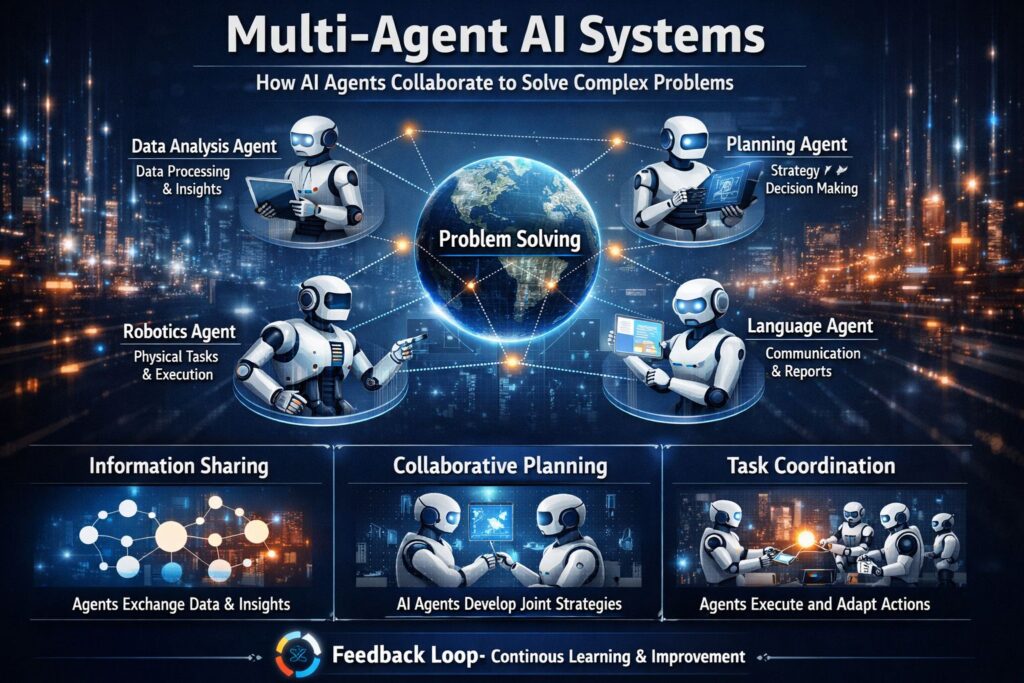

Artificial Intelligence is evolving beyond single models performing isolated tasks. The next major shift is toward Multi-Agent AI Systems—where multiple AI agents work together, communicate, and collaborate to solve complex, real-world problems.
Instead of relying on one large model, organizations are now building systems of specialized AI agents that coordinate like a team—each with its own role, expertise, and responsibility.
What Are Multi-Agent AI Systems?
A Multi-Agent AI System is a framework where multiple AI agents interact with each other to achieve a shared goal.
Each agent can:
- Perform a specific task
- Make decisions independently
- Communicate with other agents
- Share data and insights
- Adapt based on feedback
Think of it as a digital team of AI workers, where each agent specializes in a function—just like departments in a company.
Why Single AI Models Are Not Enough
Single AI models are powerful but limited when dealing with:
- Complex workflows
- Multi-step reasoning
- Cross-functional tasks
- Dynamic environments
Multi-agent systems solve these limitations by:
- Breaking problems into smaller tasks
- Assigning tasks to specialized agents
- Coordinating execution across agents
This leads to more scalable, flexible, and intelligent systems.
How Multi-Agent AI Systems Work
1. Task Decomposition
A complex problem is broken down into smaller subtasks.
Example:
A customer support system may include:
- Query understanding agent
- Knowledge retrieval agent
- Response generation agent
- Quality validation agent
2. Agent Specialization
Each agent is designed for a specific role:
- Research agent
- Planning agent
- Execution agent
- Monitoring agent
Specialization improves efficiency and accuracy.
3. Communication Between Agents
Agents exchange information using:
- Messages
- APIs
- Shared memory or context
This ensures coordination and alignment toward the final goal.
4. Decision-Making and Execution
Agents make decisions based on:
- Inputs from other agents
- Data from external systems
- Predefined objectives
They can trigger actions such as:
- Calling APIs
- Updating databases
- Sending notifications
5. Feedback and Iteration
Agents continuously learn and improve by:
- Evaluating outcomes
- Refining decisions
- Adjusting workflows
This creates a self-improving system.
Real-World Use Cases of Multi-Agent AI Systems
1. Customer Support Automation
Multiple agents handle:
- Query understanding
- Knowledge retrieval
- Response generation
- Escalation handling
Result: Faster and more accurate support.
2. AI-Powered Research Systems
Agents collaborate to:
- Search information
- Summarize data
- Validate facts
- Generate reports
Useful for analysts, researchers, and content teams.
3. Autonomous Business Workflows
AI agents manage:
- Lead qualification
- Email responses
- CRM updates
- Task scheduling
This reduces manual effort across operations.
4. Software Development Assistance
Agents can:
- Generate code
- Review code
- Test functionality
- Debug issues
Acting as a full AI-powered development team.
5. Supply Chain and Operations
Agents coordinate:
- Demand forecasting
- Inventory management
- Logistics planning
Enabling smarter and faster decisions.
Benefits of Multi-Agent AI Systems
Scalability
Easily add new agents for new tasks without redesigning the entire system.
Flexibility
Agents can be updated or replaced independently.
Efficiency
Parallel processing allows faster execution.
Accuracy
Specialized agents perform tasks better than a general-purpose model.
Automation at Scale
Complex workflows can run with minimal human intervention.
Challenges to Consider
- Coordination complexity between agents
- Communication overhead
- Error propagation across agents
- Debugging multi-agent systems
- Security and access control
Proper architecture and monitoring are essential.
Multi-Agent AI vs Single-Agent Systems
| Feature | Single-Agent AI | Multi-Agent AI |
|---|---|---|
| Task Handling | Limited | Complex workflows |
| Scalability | Low | High |
| Flexibility | Moderate | High |
| Performance | Generalized | Specialized |
| Collaboration | None | Core feature |
Popular Frameworks for Multi-Agent Systems
- LangGraph
- CrewAI
- AutoGen
- OpenAI Assistants
- Custom orchestration frameworks
These tools simplify building and managing agent-based workflows.
The Future of Multi-Agent AI Systems
Multi-agent systems are evolving toward:
- Fully autonomous workflows
- AI agents managing other AI agents
- Real-time decision-making systems
- Enterprise-wide AI orchestration
They are becoming the foundation for AI-driven organizations.
Final Thoughts
Multi-Agent AI Systems represent a shift from isolated intelligence to collaborative intelligence. By combining multiple specialized agents, businesses can solve complex problems faster, more accurately, and at scale.
The future of AI is not just smarter models—it’s smarter systems working together.