
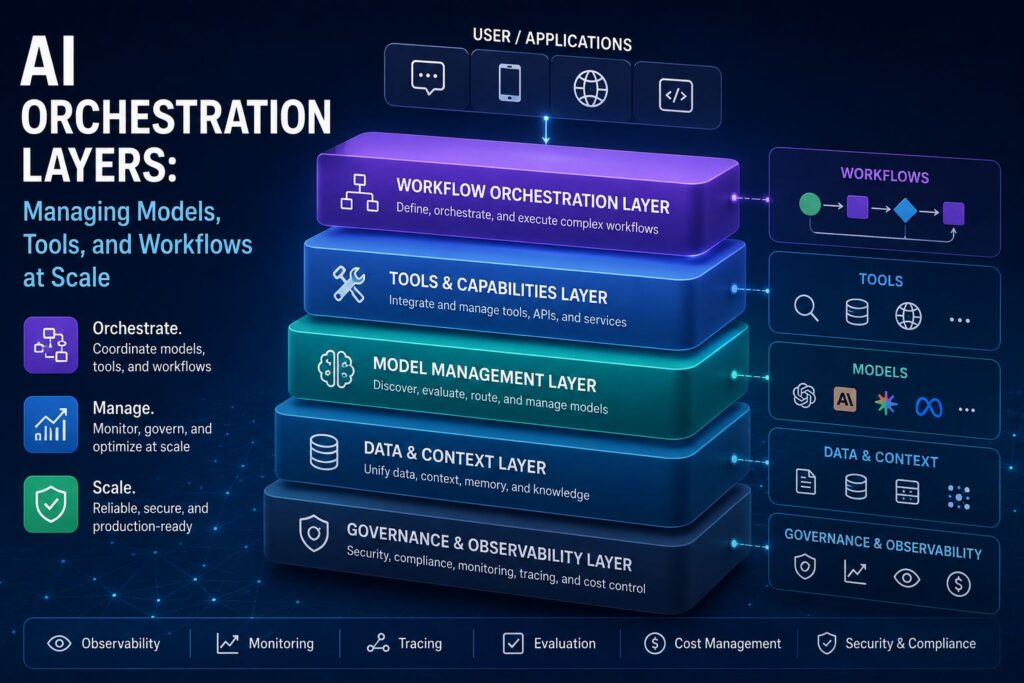

As Artificial Intelligence systems become more advanced, organizations are no longer working with a single AI model or standalone application. Modern AI ecosystems involve multiple models, APIs, databases, agents, and automation workflows working together simultaneously.
Managing this growing complexity requires a new architectural layer: the AI Orchestration Layer.
AI orchestration helps enterprises coordinate models, tools, data pipelines, and workflows efficiently—turning disconnected AI components into scalable, intelligent systems.
What Is an AI Orchestration Layer?
An AI Orchestration Layer is a system that coordinates and manages interactions between:
- AI models
- APIs and tools
- Data sources
- Vector databases
- AI agents
- Automation workflows
- External enterprise systems
It acts as the “control center” that ensures all components work together smoothly.
Instead of manually connecting systems one by one, orchestration layers automate and manage the flow of tasks, data, and decisions across the AI ecosystem.
Why AI Orchestration Matters
As organizations scale AI adoption, they face challenges such as:
- Multiple AI models for different tasks
- Complex workflows across departments
- Tool integration issues
- Inconsistent outputs
- High infrastructure complexity
Without orchestration, AI systems become fragmented and difficult to manage.
AI orchestration solves this by creating:
- Centralized workflow management
- Consistent execution pipelines
- Scalable AI operations
- Better monitoring and governance
How AI Orchestration Layers Work
1. Model Management
Organizations often use multiple models:
- LLMs for text generation
- Vision models for image analysis
- Forecasting models for analytics
The orchestration layer decides:
- Which model to use
- When to call it
- How outputs should flow to the next step
2. Tool and API Coordination
AI systems frequently interact with:
- CRMs
- Databases
- Search engines
- External APIs
- Enterprise software
Orchestration layers manage these integrations automatically.
Example:
An AI assistant may:
- Retrieve customer data from CRM
- Analyze sentiment using AI
- Generate a response
- Update support tickets automatically
3. Workflow Automation
Complex AI tasks involve multiple steps.
Orchestration layers:
- Sequence tasks
- Trigger actions
- Handle dependencies
- Retry failed operations
- Monitor workflow health
This enables reliable end-to-end automation.
4. Context and Memory Management
Modern AI applications require persistent context.
Orchestration systems help:
- Store conversation history
- Manage session memory
- Retrieve relevant knowledge dynamically
This improves personalization and accuracy.
5. Monitoring and Governance
AI orchestration layers provide:
- Logging and observability
- Performance monitoring
- Cost tracking
- Security controls
- Access management
Governance becomes critical as AI scales across enterprises.
Real-World Use Cases of AI Orchestration
1. Enterprise AI Assistants
AI assistants coordinate:
- LLMs
- Internal knowledge bases
- Workflow tools
- Scheduling systems
Delivering intelligent business automation.
2. Customer Support Automation
Orchestration systems connect:
- Chatbots
- Ticketing platforms
- Knowledge retrieval systems
- Human escalation workflows
This creates seamless support experiences.
3. AI-Powered Research Platforms
AI orchestration manages:
- Web search
- Document retrieval
- Summarization models
- Citation generation
Helping teams analyze information faster.
4. Autonomous AI Agents
Multi-agent systems require orchestration to:
- Assign tasks
- Coordinate communication
- Manage execution flow
- Prevent conflicts between agents
5. AI in Data Analytics
Orchestration layers automate:
- Data collection
- Cleaning pipelines
- Model execution
- Visualization workflows
Reducing manual operations significantly.
Key Benefits of AI Orchestration Layers
Scalability
Manage multiple AI systems and workflows efficiently.
Flexibility
Easily swap models, tools, or APIs without rebuilding the system.
Reliability
Automated retries, monitoring, and workflow management improve stability.
Faster Development
Developers focus on business logic instead of infrastructure complexity.
Better Governance
Centralized oversight improves compliance, security, and cost management.
AI Orchestration vs Traditional Automation
| Traditional Automation | AI Orchestration |
|---|---|
| Rule-based workflows | Intelligent dynamic workflows |
| Limited adaptability | Context-aware execution |
| Fixed integrations | Flexible tool coordination |
| Minimal reasoning | AI-driven decision flows |
AI orchestration enables systems to become adaptive rather than static.
Popular AI Orchestration Frameworks
Organizations commonly use:
- LangGraph
- CrewAI
- Apache Airflow
- Prefect
- AutoGen
- Kubernetes-based AI pipelines
These frameworks help manage scalable AI workflows efficiently.
Challenges of AI Orchestration
- Infrastructure complexity
- Workflow debugging difficulties
- Latency management
- Security and access control
- Integration maintenance
Proper architecture design is essential for long-term scalability.
AEO-Friendly Answer (Quick Summary)
AI orchestration layers manage and coordinate AI models, tools, APIs, and workflows to enable scalable, automated, and intelligent AI systems across enterprises.
The Future of AI Orchestration
AI orchestration is evolving toward:
- Fully autonomous enterprise systems
- Self-healing AI workflows
- Multi-agent collaboration platforms
- Real-time adaptive AI pipelines
As AI ecosystems grow, orchestration layers will become the foundation of enterprise AI infrastructure.
Final Thoughts
AI orchestration layers are transforming disconnected AI tools into unified, scalable systems. By managing models, workflows, tools, and agents centrally, organizations can build reliable AI products that operate efficiently at scale.
The future of enterprise AI is not just about powerful models—it’s about how intelligently those models work together.