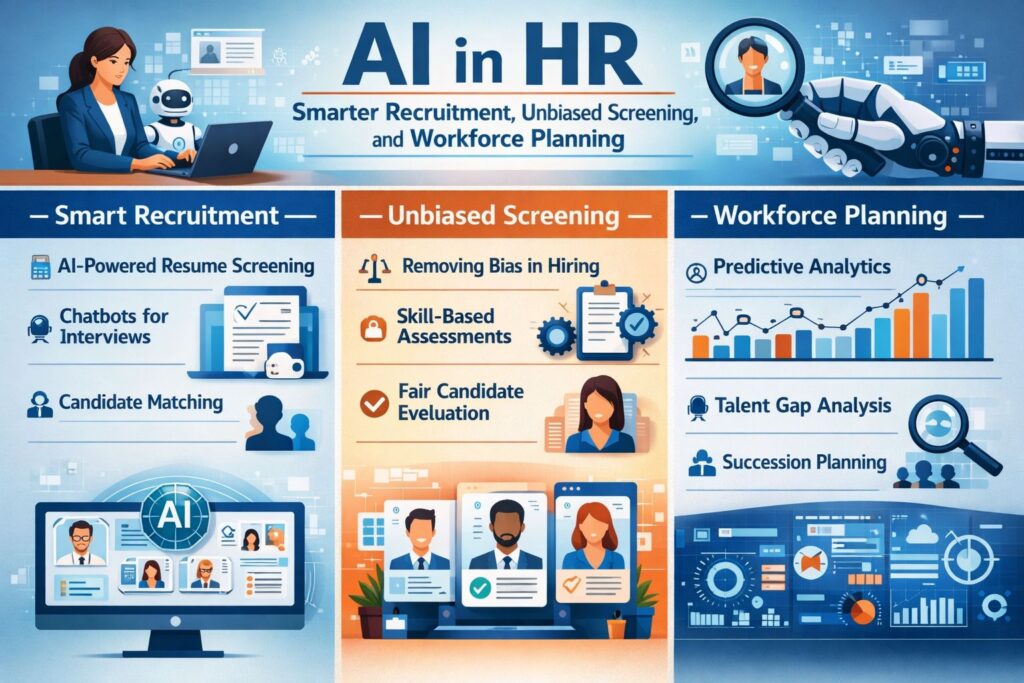

Artificial Intelligence is transforming Human Resources from a reactive function into a data-driven, strategic powerhouse. From hiring the right candidates to planning future workforce needs, AI is helping HR teams work faster, smarter, and more objectively.
Organizations are now leveraging AI to:
- Automate repetitive HR tasks
- Improve hiring accuracy
- Reduce bias in recruitment
- Predict workforce trends
- Enhance employee experience
AI in HR is not about replacing people—it’s about empowering HR professionals to make better decisions.
What Is AI in HR?
AI in HR refers to the use of machine learning, data analytics, and intelligent automation to improve HR processes such as:
- Recruitment and hiring
- Candidate screening
- Employee engagement
- Performance management
- Workforce planning
AI systems analyze large volumes of data to identify patterns, make predictions, and recommend actions.
How AI Is Transforming Recruitment
1. Automated Candidate Sourcing
AI tools scan job portals, LinkedIn profiles, and databases to identify the best candidates based on skills, experience, and role requirements.
Benefits:
- Faster talent discovery
- Wider candidate reach
- Reduced manual effort
2. Resume Screening at Scale
AI can process thousands of resumes in minutes, shortlisting candidates based on predefined criteria.
Key capabilities:
- Skill matching
- Experience analysis
- Keyword and context understanding
This reduces hiring time significantly.
3. AI-Powered Interview Assistance
AI tools assist in:
- Scheduling interviews
- Conducting initial screening interviews
- Analyzing candidate responses
Some systems even evaluate communication skills and sentiment.
4. Predictive Hiring Decisions
AI uses historical hiring data to predict:
- Candidate success probability
- Cultural fit
- Retention likelihood
This leads to better hiring outcomes.
Reducing Bias with AI in Screening
One of the biggest advantages of AI in HR is its ability to reduce human bias—when implemented correctly.
How AI Helps:
- Focuses on skills and qualifications instead of personal attributes
- Standardizes evaluation criteria
- Removes unconscious bias in initial screening
Important Note:
AI must be trained on diverse and unbiased data. Otherwise, it can unintentionally replicate bias.
Responsible AI implementation is critical.
AI in Workforce Planning
Workforce planning is no longer based on guesswork. AI enables organizations to make predictive and strategic decisions.
1. Demand Forecasting
AI predicts future hiring needs based on:
- Business growth
- Market trends
- Historical data
2. Skill Gap Analysis
AI identifies:
- Missing skills in the workforce
- Training requirements
- Upskilling opportunities
3. Employee Retention Prediction
AI analyzes patterns to identify employees who may leave, enabling proactive retention strategies.
4. Resource Optimization
AI helps allocate the right talent to the right projects at the right time.
Benefits of AI in HR
Faster Hiring
Reduce time-to-hire through automation and intelligent screening.
Better Decision-Making
Use data-driven insights instead of intuition.
Improved Candidate Experience
Faster responses and smoother hiring processes.
Reduced Bias
More objective and consistent evaluations.
Cost Efficiency
Lower recruitment and operational costs.
Challenges of AI in HR
- Data privacy concerns
- Risk of biased training data
- Lack of transparency in decision-making
- Resistance to change within organizations
- Need for human oversight
AI should support HR—not replace human judgment.
Best Practices for Implementing AI in HR
- Start with high-impact use cases like recruitment
- Ensure data quality and diversity
- Maintain human-in-the-loop decision-making
- Regularly audit AI systems for bias
- Be transparent with candidates about AI usage
Responsible implementation builds trust and effectiveness.
The Future of AI in HR
AI will continue to evolve HR into a strategic function by enabling:
- Personalized employee experiences
- Continuous performance insights
- Intelligent career pathing
- Autonomous HR workflows
HR teams will increasingly focus on strategy, culture, and people, while AI handles repetitive processes.
Final Thoughts
AI is redefining HR by making it faster, smarter, and more objective. From hiring the right talent to planning the workforce of the future, AI empowers organizations to build stronger teams and better workplaces.
The key is not just adopting AI—but using it responsibly, ethically, and strategically.