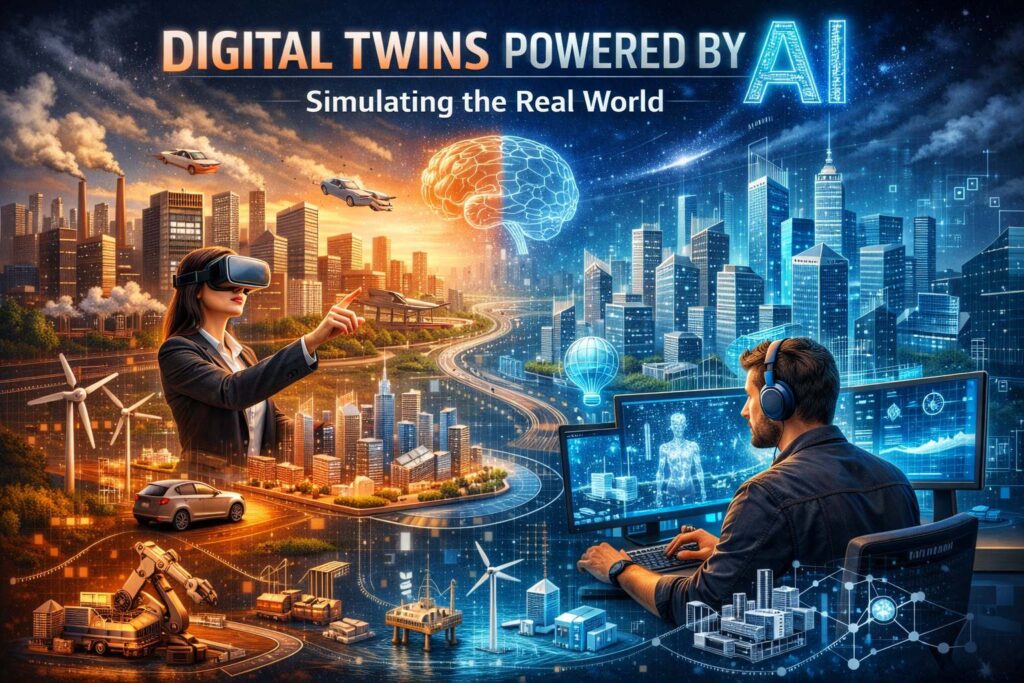

Industries are rapidly moving from reactive systems to predictive and autonomous systems. At the center of this transformation is a powerful concept: Digital Twins powered by AI.
Digital twins allow businesses to simulate, monitor, and optimize real-world systems in a virtual environment — using artificial intelligence to make those simulations smarter, faster, and more predictive.
From manufacturing plants to smart cities, AI-powered digital twins are redefining how organizations operate.
What Is a Digital Twin?
A digital twin is a virtual replica of a physical object, system, or process that updates in real time using data from sensors and connected devices.
It mirrors:
- Physical assets (machines, buildings, vehicles)
- Processes (manufacturing workflows, logistics networks)
- Entire environments (cities, power grids, healthcare systems)
When AI is integrated into digital twins, the system doesn’t just replicate reality — it learns, predicts, and optimizes outcomes.
How AI Enhances Digital Twins
Traditional simulations rely on predefined rules. AI-powered digital twins go further by:
- Analyzing historical and real-time data
- Predicting failures before they happen
- Optimizing performance dynamically
- Learning from patterns over time
- Recommending autonomous actions
AI transforms digital twins from static dashboards into intelligent decision-making systems.
How AI-Powered Digital Twins Work
1. Data Collection
IoT sensors collect real-time data from physical assets:
- Temperature
- Pressure
- Motion
- Usage patterns
- Environmental conditions
This data feeds into the digital twin continuously.
2. Virtual Modeling
A virtual model replicates the physical system using simulation software and data integration platforms.
3. AI & Machine Learning Layer
Machine learning models:
- Detect anomalies
- Predict equipment failure
- Forecast demand
- Optimize resource usage
AI continuously improves predictions as more data is collected.
4. Insights & Automation
The system generates:
- Predictive alerts
- Performance recommendations
- Automated adjustments
- Scenario simulations
Organizations can test decisions in a virtual environment before applying them in the real world.
Real-World Applications of AI-Powered Digital Twins
1. Manufacturing
- Predictive maintenance for machines
- Reducing downtime
- Optimizing production workflows
- Improving supply chain visibility
2. Smart Cities
- Traffic flow optimization
- Energy grid management
- Urban planning simulations
- Environmental monitoring
3. Healthcare
- Modeling patient treatment outcomes
- Hospital resource optimization
- Medical equipment performance tracking
4. Energy & Utilities
- Power grid simulation
- Renewable energy forecasting
- Asset lifecycle management
5. Aerospace & Automotive
- Vehicle performance simulation
- Aircraft engine monitoring
- Autonomous system testing
Benefits of AI-Powered Digital Twins
Predictive Maintenance
Identify failures before breakdowns occur, reducing repair costs.
Cost Optimization
Improve operational efficiency and reduce waste.
Faster Innovation
Test products and processes virtually before deployment.
Risk Reduction
Simulate worst-case scenarios safely.
Data-Driven Decision Making
Make decisions based on real-time intelligence.
Digital Twins vs Traditional Simulation
| Traditional Simulation | AI-Powered Digital Twin |
|---|---|
| Static models | Dynamic real-time models |
| Manual updates | Continuous data integration |
| Rule-based predictions | Machine learning predictions |
| Limited adaptability | Self-improving systems |
AI brings adaptability and intelligence to simulations.
Challenges to Consider
- High initial setup cost
- Complex data integration
- Cybersecurity risks
- Infrastructure requirements
- Data quality dependency
Successful implementation requires a strong data and AI strategy.
The Future of Digital Twins
As AI models become more advanced and edge computing expands, digital twins will:
- Operate in real time at scale
- Integrate with autonomous AI agents
- Enable smarter smart cities
- Power sustainable infrastructure
- Drive fully predictive enterprises
Digital twins are evolving from monitoring tools to decision engines.
Final Thoughts
AI-powered digital twins are bridging the gap between the physical and digital worlds. By combining IoT, data analytics, and machine learning, organizations can simulate reality, predict outcomes, and optimize systems before problems arise.
The future of innovation isn’t just physical — it’s simulated, intelligent, and AI-driven.