
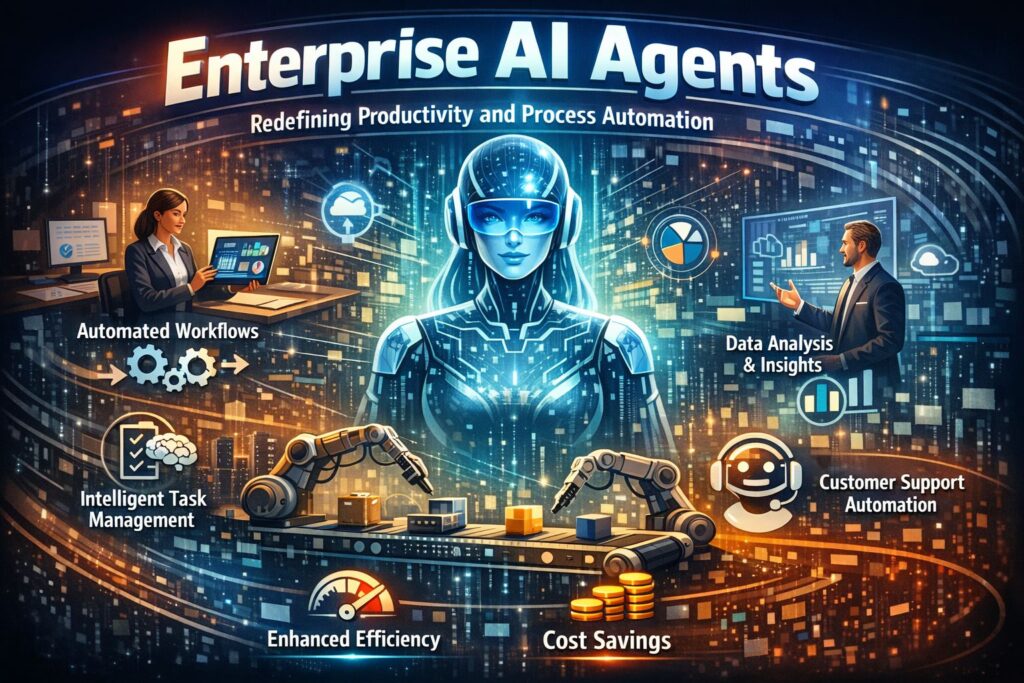

Artificial intelligence in enterprises has moved far beyond chatbots and analytics dashboards. Organizations are now deploying Enterprise AI Agents—intelligent systems capable of planning, reasoning, and executing tasks across business operations.
These agents are redefining productivity by automating complex workflows, reducing manual effort, and enabling teams to focus on strategic work.
What Are Enterprise AI Agents?
Enterprise AI Agents are autonomous software systems designed to:
- Understand business objectives
- Break goals into actionable steps
- Interact with enterprise tools and databases
- Make decisions based on context
- Execute tasks independently
- Learn from outcomes over time
Unlike traditional automation, AI agents do not rely solely on rigid rules. They adapt, reason, and improve continuously.
How Enterprise AI Agents Work
A typical enterprise AI agent architecture includes:
- Reasoning Engine – Interprets goals and decides actions
- Memory Layer – Maintains short-term context and long-term knowledge
- Tool Integrations – Connects with CRM, ERP, HRMS, email, and internal systems
- Task Planner – Breaks objectives into executable steps
- Execution Module – Performs actions and monitors results
- Feedback Loop – Learns from successes and failures
This structure enables AI agents to operate seamlessly across departments and systems.
Why Enterprise AI Agents Matter
Modern enterprises face increasing operational complexity, rising costs, and pressure to move faster with fewer resources. Enterprise AI agents address these challenges by acting as digital workers that operate continuously and consistently.
Key Benefits
- Higher productivity
- End-to-end process automation
- Intelligent decision support
- Reduced turnaround time
- Lower operational costs
- Scalable execution across teams
Enterprise AI Agent Use Cases
1. Customer Support Operations
AI agents can:
- Handle customer inquiries
- Retrieve data from CRM systems
- Create and update support tickets
- Route or escalate issues automatically
- Follow up without human intervention
This results in faster resolution and improved customer experience.
2. Sales & Revenue Operations
Enterprise AI agents support sales teams by:
- Qualifying and scoring leads
- Updating CRM records
- Sending personalized follow-ups
- Generating deal summaries
- Assisting with pipeline forecasting
Sales teams spend more time selling and less time on administration.
3. Finance & Accounting
AI agents automate financial workflows such as:
- Invoice processing
- Expense categorization
- Compliance checks
- Financial reporting and reconciliation
This improves accuracy and shortens financial close cycles.
4. HR & Talent Management
AI agents help HR teams by:
- Screening resumes
- Scheduling interviews
- Managing onboarding workflows
- Answering employee policy questions
This enhances both hiring efficiency and employee experience.
5. IT & Operations
In IT environments, AI agents:
- Monitor system logs and alerts
- Detect anomalies
- Resolve incidents automatically
- Route tickets to the right teams
This enables proactive and self-healing operations.
Enterprise AI Agents vs Traditional Automation
| Feature | Traditional Automation | Enterprise AI Agents |
|---|---|---|
| Decision Making | Rule-based | Context-aware |
| Adaptability | Low | High |
| Learning Capability | None | Continuous |
| Multi-System Interaction | Limited | Extensive |
| Scalability | Moderate | Enterprise-grade |
Popular Platforms for Enterprise AI Agents
Organizations commonly build or deploy AI agents using:
- LangGraph
- CrewAI
- AutoGen
- Microsoft Copilot Studio
- Salesforce Einstein
- OpenAI Assistants
These platforms support secure, scalable, and multi-agent workflows.
Security, Governance & Compliance
For enterprise adoption, AI agents must include:
- Role-based access controls
- Audit logs and activity tracking
- Data isolation and encryption
- Human-in-the-loop approvals
- Compliance with regulatory standards
Strong governance ensures trust and responsible deployment.
How to Get Started with Enterprise AI Agents
- Identify repetitive, high-impact workflows
- Start with a single agent use case
- Integrate with existing enterprise systems
- Add monitoring and approval layers
- Expand to multi-agent workflows
A phased approach ensures faster adoption with minimal risk.
The Future of Enterprise AI Agents
Enterprise AI agents are evolving into:
- Collaborative multi-agent systems
- AI supervisors managing digital workers
- Fully autonomous cross-department workflows
- Continuous optimization engines
AI agents are becoming a foundational layer of modern enterprises.
Conclusion
Enterprise AI Agents represent a fundamental shift from basic automation to intelligent, autonomous operations.
Organizations that embrace AI agents gain:
- Faster execution
- Reduced operational overhead
- Smarter decision-making
- Sustainable competitive advantage
Enterprise productivity is no longer driven by tools alone—it is powered by intelligent agents.



Good explanation on AI Agents