
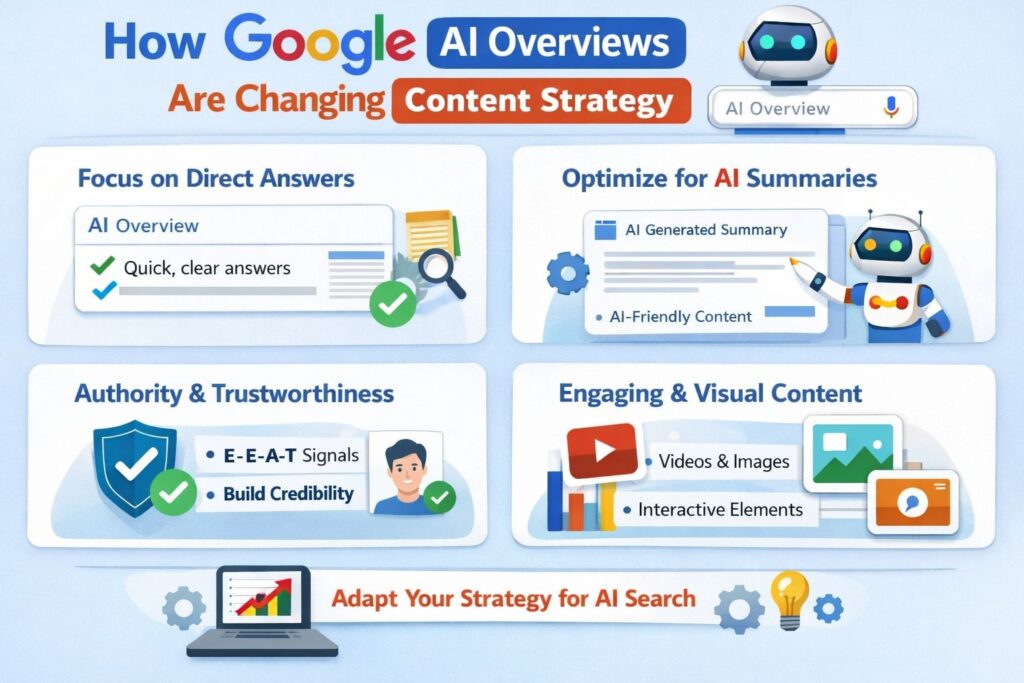

Search is undergoing its biggest transformation in decades. Instead of showing only a list of links, modern search now delivers AI-generated summaries directly on the results page. These summaries—known as AI Overviews—are reshaping how users consume information and how brands must create content.
For businesses, marketers, and publishers, this shift demands a new approach: optimizing not just for rankings, but for visibility inside AI answers.
What Are AI Overviews?
AI Overviews are AI-generated summaries that appear at the top of search results for many queries. They combine insights from multiple sources to provide a concise, conversational answer.
Key characteristics:
- Provide direct answers without requiring clicks
- Cite multiple websites as sources
- Handle complex, multi-part questions
- Present information in an easy-to-read format
In many cases, users get everything they need without visiting any website.
Why AI Overviews Matter for Content Creators
1. Decline in Traditional Click Traffic
Because answers appear directly in search results, fewer users click through to individual websites. High rankings alone no longer guarantee traffic.
However, visibility inside AI Overviews can still drive:
- Brand awareness
- Authority recognition
- Indirect traffic
- Trust signals
The goal is shifting from “getting the click” to “being the source.”
2. Rise of Zero-Click Search
Zero-click searches occur when users find answers without leaving the search page. AI Overviews accelerate this trend significantly.
Content strategies must now account for:
- Reduced dependence on page visits
- Increased importance of brand presence
- New success metrics beyond traffic
3. Higher Bar for Content Quality
AI systems prioritize content that is:
- Accurate and trustworthy
- Well-structured
- Comprehensive yet concise
- Written with clear intent
Thin or generic content is less likely to be cited.
How AI Overviews Select Content
AI systems evaluate multiple signals when choosing sources:
- Relevance to the query
- Topical authority
- Clarity of explanations
- Structured formatting
- Freshness of information
- Trustworthiness
Content that answers questions directly and confidently has the best chance of inclusion.
How Content Strategy Must Evolve
1. Shift From Keyword-Only to Intent-First Content
Traditional SEO focused heavily on exact keywords. AI search focuses on user intent and context.
Instead of optimizing for:
“best project management tools”
Create content that answers:
- What are project management tools?
- Which tool is best for small teams?
- How do they compare?
- When should you use them?
Intent-driven content performs better in AI summaries.
2. Prioritize Answer-First Writing
Start sections with a direct answer before expanding.
Example:
AI Overviews are AI-generated summaries that provide quick answers at the top of search results.
This structure is ideal for AI extraction.
3. Use Clear Structure and Formatting
AI systems prefer content that is easy to parse.
Best practices include:
- Descriptive headings
- Short paragraphs
- Bullet points and numbered lists
- Tables for comparisons
- Logical content flow
Avoid dense blocks of text.
4. Build Topical Authority, Not Just Individual Pages
AI Overviews often pull from sources that demonstrate deep expertise.
Create content clusters around core topics:
- Pillar articles
- Supporting guides
- FAQs
- Case studies
- How-to tutorials
Authority across a topic increases citation likelihood.
5. Optimize for AEO (Answer Engine Optimization)
AEO focuses on making your content usable as a direct answer.
Key AEO techniques:
- Question-based headings
- Concise definitions
- Fact-based explanations
- Structured data (schema)
- Clear authorship
AEO complements traditional SEO rather than replacing it.
6. Strengthen Brand Signals
Even if users don’t click, repeated exposure builds trust.
Ensure your brand is visible through:
- Consistent tone and messaging
- Author bios and credentials
- Unique insights or data
- Clear positioning
Over time, users may search specifically for your brand.
Measuring Success in the AI Overview Era
Traditional metrics alone are no longer sufficient.
New indicators include:
- Inclusion in AI summaries
- Growth in impressions
- Brand search volume
- Direct traffic increases
- Engagement quality
Visibility is becoming as important as traffic.
Common Mistakes to Avoid
- Writing long introductions before answering the question
- Over-optimizing for keywords
- Publishing shallow or repetitive content
- Ignoring structure and readability
- Producing content without clear expertise
AI systems reward usefulness, not volume.
The Future of Search Is Conversational
Search is evolving from a navigation tool into a knowledge assistant. Users increasingly ask complex questions and expect synthesized answers.
Content creators who adapt early will:
- Maintain visibility despite fewer clicks
- Build stronger authority
- Reach users earlier in decision journeys
- Stay competitive in AI-driven search
Final Thoughts
AI Overviews are not the end of content marketing—they are a transformation of it. Success now depends on creating content that is clear, authoritative, structured, and genuinely helpful.
In the new search landscape, winning isn’t about being ranked first.
It’s about being trusted enough to be summarized.