
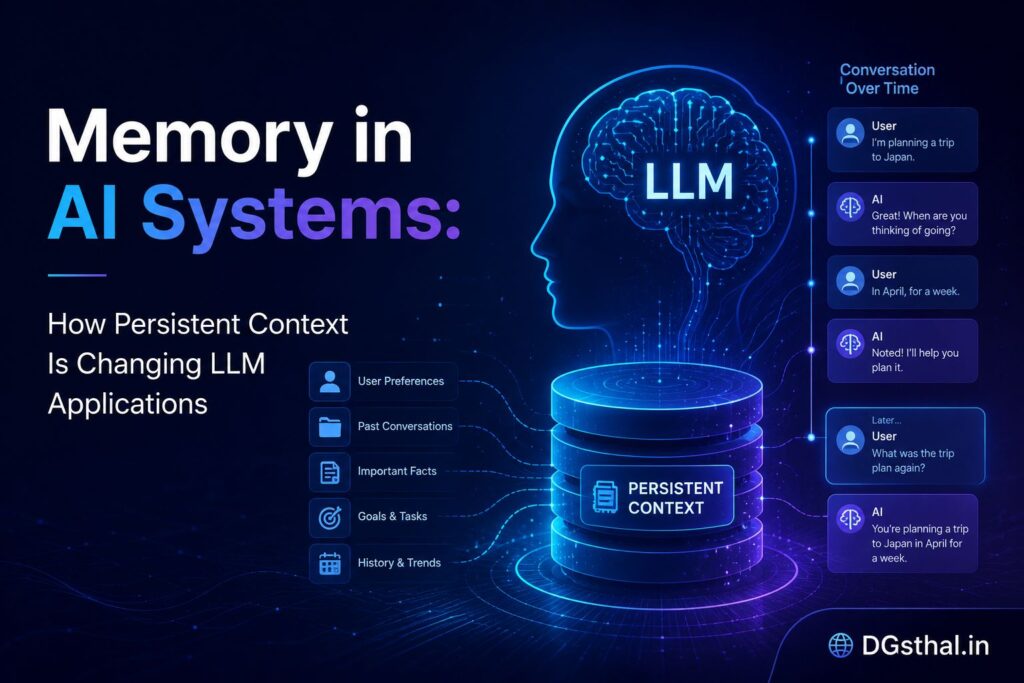

Artificial Intelligence has made remarkable progress in understanding and generating human-like text. However, one of the biggest limitations of traditional Large Language Models (LLMs) has been their inability to remember information across interactions.
This challenge is now being addressed through AI memory systems, which enable LLMs to retain, retrieve, and utilize context over time. By introducing persistent memory, AI applications are becoming more personalized, intelligent, and capable of handling complex workflows.
From AI assistants and customer support platforms to enterprise automation systems, memory is rapidly becoming a foundational component of modern AI architecture.
What Is Memory in AI Systems?
Memory in AI systems refers to the ability of an AI application to store and recall information from previous interactions, workflows, or external knowledge sources.
Instead of treating every interaction as completely new, AI systems with memory can:
- Remember user preferences
- Retain conversation history
- Track ongoing tasks
- Learn from previous interactions
- Access historical knowledge when needed
This transforms AI from a reactive tool into a more intelligent and context-aware assistant.
Why Traditional LLMs Struggle with Memory
Most LLMs operate within a fixed context window.
While they can process large amounts of information during a single interaction, they typically cannot:
- Remember past conversations indefinitely
- Retain user preferences across sessions
- Track long-running projects
- Learn from previous outcomes
Once the context window is exceeded or a session ends, the information is lost.
This creates challenges for enterprise applications that require continuity and long-term context.
What Is Persistent Context?
Persistent context refers to information that remains available across multiple interactions and sessions.
Instead of relying solely on temporary prompts, AI systems can access stored information whenever needed.
Examples include:
- Customer interaction history
- Project details and milestones
- User preferences
- Organizational knowledge
- Previously completed tasks
Persistent context enables AI to deliver more relevant and personalized responses.
Types of Memory in AI Systems
1. Short-Term Memory
Short-term memory stores information within the current interaction.
Examples:
- Current conversation context
- Active tasks
- Temporary instructions
This memory typically exists only during a session.
2. Long-Term Memory
Long-term memory stores information for future use.
Examples:
- User preferences
- Historical conversations
- Business rules
- Organizational knowledge
This allows AI systems to provide continuity across sessions.
3. Episodic Memory
Episodic memory focuses on past events and experiences.
For example:
- Previous support tickets
- Earlier project discussions
- Prior recommendations
This helps AI understand context based on historical interactions.
4. Semantic Memory
Semantic memory stores structured knowledge and facts.
Examples:
- Company policies
- Product documentation
- Industry regulations
- Knowledge base articles
This improves factual accuracy and retrieval.
How Memory Works in Modern AI Systems
Step 1: Capture Information
The AI identifies important information during interactions.
Examples:
- User goals
- Preferences
- Decisions
- Tasks
Step 2: Store Information
Relevant data is stored in:
- Databases
- Vector databases
- Knowledge repositories
- Memory services
Not all information is stored—only valuable context.
Step 3: Retrieve Context
When a new interaction begins, the AI retrieves relevant memories.
Retrieval can be based on:
- User identity
- Similar conversations
- Project references
- Semantic search
Step 4: Augment Responses
Retrieved memories are added to the prompt context before generating a response.
This enables personalized and context-aware outputs.
Why Memory Is Transforming LLM Applications
Personalized AI Assistants
Memory allows assistants to remember:
- User preferences
- Communication styles
- Frequently used information
This creates a more natural experience.
Smarter Customer Support
AI can remember:
- Previous support cases
- Customer history
- Product usage details
Resulting in faster issue resolution.
Enterprise Knowledge Management
Memory systems allow AI to access:
- Internal documentation
- Policies
- Historical decisions
This improves organizational productivity.
Long-Running AI Workflows
AI agents can track:
- Project progress
- Pending tasks
- Dependencies
Making autonomous workflows more reliable.
Memory and Retrieval-Augmented Generation (RAG)
Memory systems often work alongside Retrieval-Augmented Generation (RAG).
RAG Provides:
- Access to external knowledge
- Real-time information retrieval
Memory Provides:
- Personalized context
- Historical interactions
Together, they create more accurate and context-rich AI experiences.
Benefits of Memory-Enabled AI Systems
Better User Experience
AI feels more conversational and intelligent.
Increased Productivity
Users spend less time repeating information.
Improved Accuracy
Responses leverage historical context.
Enhanced Personalization
Recommendations become more relevant over time.
Stronger Automation
AI agents can manage complex, multi-step workflows.
Challenges of AI Memory Systems
Privacy and Security
Organizations must protect stored user data and sensitive information.
Memory Management
Determining what to store and what to forget is critical.
Retrieval Accuracy
Poor retrieval can introduce irrelevant context.
Scalability
Managing memory across millions of users requires robust infrastructure.
Popular Technologies Supporting AI Memory
Modern AI memory systems often utilize:
- Vector databases
- Knowledge graphs
- Semantic search engines
- Retrieval frameworks
- Memory management layers
These technologies enable efficient storage and retrieval of context.
AEO-Friendly Answer (Quick Summary)
Memory in AI systems enables Large Language Models to store, retrieve, and use information from past interactions, creating more personalized, accurate, and context-aware AI applications.
The Future of Memory in AI
Future AI systems will move beyond simple chat interactions and become long-term collaborators.
Emerging trends include:
- Persistent AI assistants
- Personalized enterprise copilots
- Self-improving AI agents
- Context-aware autonomous workflows
- AI systems with organizational memory
Memory will become as important as reasoning in next-generation AI architectures.
Final Thoughts
The next evolution of AI is not just about bigger models or better reasoning—it is about remembering.
By introducing persistent context, AI systems can understand users more deeply, maintain continuity across interactions, and support increasingly complex workflows.
As enterprises adopt AI at scale, memory-enabled systems will become the foundation of intelligent, personalized, and autonomous applications.